
AI tax prep risks for business owners are getting harder to ignore. About 25% of Americans say they plan to use AI to help file their taxes this year, which sounds efficient until you remember how quickly things break when a return involves K-1s, 1099s, multiple entities, state issues, or recent law changes.
AI tax prep sounds like the dream.
Upload the bank statements. Pull the expenses. Sort the documents. Let the machine do the heavy lifting.
And I understand the appeal.
Pulling together business expenses, payroll records, prior-year returns, K-1s, 1099s, bank statements, entity documents, receipts, and every other stray form that shows up in tax season is exhausting. Automating the mess sounds efficient. Clean. Easy.
But there is a difference between using AI as an assistant and trusting it as an advisor.
That difference matters more the minute your return stops being simple.
If you are a W-2 employee with a straightforward return, the risk is one thing. If you run a business, deal with pass-through income, have multiple entities, have state filing issues, or need to apply new tax law correctly, “close enough” is not close enough.
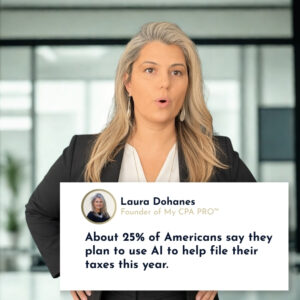
More taxpayers are clearly warming to AI.
That should not surprise anyone. Tax prep is tedious. People want speed. They want fewer documents, fewer headaches, fewer hours spent hunting through folders and email chains.
But the recent coverage that got attention made the real problem hard to ignore: AI can sound certain while still being wrong, outdated, incomplete, or context-blind.
That is not a small issue in tax work. That is the whole issue.
People talk about tax prep like it is just moving numbers from one place to another.
Sometimes it is.
But business-owner returns are rarely that simple. They are a chain of decisions. One bad assumption flows into the next one.
And business owners do not live in a one-form world.
That is exactly where confident software starts to get dangerous.
A fair stress test is whether an AI tool can correctly handle recent law changes that directly affect business owners.
That is exactly the kind of test that matters in the real world, because recent law changes are where stale tools break first.
The IRS says the One Big Beautiful Bill Act was signed into law on July 4, 2025, and that it significantly affects federal taxes, credits, and deductions. You can review the official IRS summary of One Big Beautiful Bill provisions for the current agency guidance. The IRS has also published updates showing that the SALT deduction cap increased for many itemizers and that the qualified business income deduction was made permanent under recent legislation.
So when a tool misses current law, that is not a harmless glitch. That is a business owner making decisions from stale inputs.
And that is the deeper point here: if AI can be outdated on law that already passed, why would you trust it to reason through a multi-entity tax strategy that depends on your facts, your timing, your state, and your long-term plan?
For a closer look at where AI fits and where it does not where it does not, read The Simulator Era: What AI Can and Cannot Do for Your Tax Strategy.
Need help pressure-testing your structure before you file? Schedule a Free Tax Strategy Session.
AI can hand you a clean-looking forecast built on assumptions it cannot explain well enough.
It does not know your biggest client pays 60 days late every Q3. It does not know a vendor renegotiation is closing next month. It does not know your payroll spikes seasonally, your debt service changes after one covenant test, or that a distribution you planned in June now needs to wait until September.
It can model what you feed it. It cannot independently know what matters.
S corporation versus C corporation versus partnership versus a holding company structure is not a trivia question. It is a context-dependent decision tied to revenue, payroll, state taxes, owner compensation, reinvestment plans, and exit goals.
AI can list pros and cons. That does not mean it can evaluate your situation correctly.
And if it starts with an outdated tax assumption, the entire recommendation is crooked from the first sentence.
People underestimate this one because categorizing transactions looks mechanical.
It is not always mechanical.
Bookkeeping affects basis. It affects cash flow visibility. It affects whether your tax return starts from clean numbers or contaminated ones. If a tool misreads a form, misses context, or categorizes transactions based on pattern instead of judgment, those mistakes do not stay small for long.
Now multiply that across multiple accounts, multiple entities, intercompany transfers, owner draws, reimbursements, loan activity, and payroll-related entries.
That is not where I want a business owner relying on “probably right.”
This is the part that never changes: the IRS does not care if the bot told you.
Liability stays with the taxpayer. Every time.
If income is omitted, if a deduction is unsupported, if an election is mishandled, if a state filing gets missed, if basis is wrong, or if estimated payments were calculated from bad assumptions, the problem belongs to the business owner.
Not the software. Not the chatbot. Not the prompt.
I am not saying do not use AI.
I am using it carefully. I am evaluating where it can actually help. And there are places where it can be useful.
That is where AI shines: support work, not judgment work.
Use it to speed up the admin side. Do not hand it the steering wheel.
There is also the privacy side of this.
Business tax files are not harmless documents. They contain Social Security numbers, EINs, payroll data, ownership percentages, bank details, income history, addresses, and highly sensitive financial records.
Before you upload any of that into an AI system, you should know exactly where the data goes, who can access it, how long it is retained, whether it is used for training, and whether that use fits your own privacy and professional standards.
Efficiency is not a good trade if it creates a new exposure.
For a business doing $5M to $20M, the financial picture is too interconnected for “close enough.”
Your tax strategy affects your entity structure. Your entity structure affects your cash flow. Your cash flow affects how and when you hire, invest, distribute, borrow, and grow.
One wrong assumption in that chain does not just cost you money.
It costs you options.
That is the difference between software that processes and a professional who thinks.
If you already have a strategy on paper but are unsure whether it has been implemented correctly, read the Tax Strategy Implementation Guide.
AI can help you move faster.
It can help you get organized.
It can help you prepare better questions.
But it is not the person responsible for seeing the whole board.
And for business owners, that is the part that matters most.
Download the Tax Savings Checklist and Schedule a Free Tax Strategy Session if you want a human being to look at the full chain instead of just processing pieces of it.
It can help organize inputs, summarize documents, and surface questions. That is different from reliably preparing a business return that involves judgment, elections, recent law changes, and multi-form coordination.
Not automatically. Before uploading tax records, you need to understand how the platform stores data, who can access it, whether the data is retained, and whether it may be used beyond your immediate session.
It can describe general rules. It cannot responsibly make that decision without your actual facts, including revenue, payroll, state issues, owner goals, reinvestment plans, and long-term exit strategy.
Sometimes. But that is the point: sometimes is not good enough. You still need to verify current law against live IRS guidance and make sure the analysis reflects your actual filing position.
The best use is support: document organization, summaries, draft checklists, and preparing smarter questions. The worst use is outsourcing judgment you do not know how to verify.
Disclaimer: This article is for general educational purposes only and is not legal, tax, or accounting advice for your specific situation.

© 2026 My CPA Pro, P.C.
Laguna Beach, California · (949) 208-9087
Serving business owners throughout the United States